
Long before James Bond, and long before Sir Sean Connery, little baby "Tommy" Connery, son of Joe Connery, a truck driver, and Euphemia, a laundress, was born on August 25, 1930 in Fountainbridge, Scotland. The Connerys lived in a neighborhood where the stench of the local rubber factory and brewery was known as "the street of a thousand smells." Their home was a two-room apartment where the baby slept in a dresser drawer because they couldn't afford a crib. Joe Connery only brought home a few shillings a week, which was often spent on whiskey and gambling. Tommy grew up on the streets of Fountainbridge, where the local gangs called him "Big Tam" because of his size and eventual ability to dominate his fellow gamblers. He went to the local Tollcross elementary school and was smart and quick, grasping the basics of mathematics, reading avidly and making up fantastic stories of Martians and madmen. From an early age he loved going to the movies and often skipped school to go to Blue Halls, the local cinema, to watch the films.
When Tommy was eight years old, his brother Neil was born, and he thoroughly enjoyed being his big brother. The boys were inseparable and would fish in the local canal using their mother's stockings as fishing line. Together, the brothers often skipped school and hung out with some kids from the slum area.
Tommy Connery left school at thirteen and joined the Saint Cuthbert Cooperative Society. He grew quickly and at eighteen he was 6'3" tall. His full name was Thomas Sean Connery and, in addition to Tommy, he was also known as Sean long before he became an actor. As a young man, he had an Irish friend named Séamus, and those who knew them both had decided to call Connery by his middle name whenever they were both present. The name stuck. Three years later, he enlisted in the British Royal Navy and got two tattoos on his arm. He still has them: “Mum and Dad” and “Scotland Forever”. Although he signed on for seven years, he was released after three due to a duodenal ulcer. He returned to his occupation at Saint Cuthbert's Co-operative Society and saved money to become a member of the Dunedin Weightlifting Club, “not so much to be fit, but to look good in front of the girls.” Beginning in 1951, he trained intensively with a British Army gymnastics instructor. His fellow gymnasts nominated him for the Mister Universe contest. In 1953, he traveled nine hours to get to London, where the competitions were being held. He presented himself as “Mister Scotland”, was elected third in the tall men's category and received a medal.
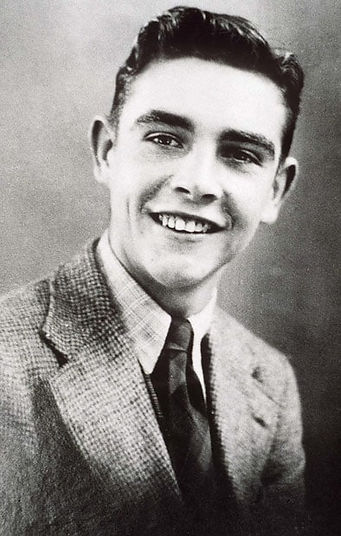

Connery in his youth and in his years in the navy.
Connery was a keen footballer and played for Bonnyrigg Rose in his youth, where he was offered a trial with East Fife. In a soccer match against a local team that Matt Busby, manager of Manchester United, was following closely, Busby offered Connery a £25 a week contract and he was tempted to accept. " I realized that an elite footballer could be finished at 30, and I was already 23. I decided to become an actor and it turned out to be one of my smartest decisions."
While in London at the Mr. Universe contest, and after receiving his medal, a local casting director liked the tall Scottish boy's looks and asked him to join the chorus of South Pacific, a new Rodgers and Hammerstein musical playing at Drury Lane in London's theater district. "I didn't have a voice and I couldn't dance. But I could look good standing there." and took himself under the wing of a venerable stage actor, Robert Henderson, who prescribed a rigorous diet of highbrow literature: Stanislavsky, Proust complete, Thomas Wolfe. Just as he had exercised his muscles with weights, he now assiduously cultivated his mind: this was self-improvement taken to the extreme.


Connery during the Mr. Universe contest and as a boxer during his bodybuilding days

Sean Connery entering his golf club
Although he received little formal training, Connery studied for three years with Yat Malmgren, a Swedish dancer. Despite his difficulties in finding work - his pronounced Edinburgh accent irritated many casting directors - he was more interested in movement and gesture than elocution. He was convinced that information on screen could be conveyed visually: it did not need to be spelled out.
A single rehearsal was enough for Connery to decide to go all in and devote himself entirely to acting. It was then that he chose the stage name Sean Connery. “It seemed to go more with my image than Tom or Tommy.”
Sean Connery was cast as a chorus member in the 1953 South Pacific. By the time the production arrived in Edinburgh, he had already been cast as Marine Corporal Hamilton Steeves and was understudying two of the juvenile leads. His salary was raised from 12 pounds to 14 pounds 10 shillings a week. The following year, upon returning to Edinburgh, Connery was promoted to the lead role of Lieutenant Buzz Adams. In Edinburgh, Connery was attacked by the notorious Valdor gang, one of the most ruthless in the city. Six gang members followed him to a 15-foot-high balcony in the Palais de Danse. There, Connery launched a solo attack on the gang members, grabbing one by the neck and another by the biceps and bashing their heads in. From then on, the gang treated him with great respect and he earned a reputation as a tough character.
Connery's first passion was not acting. Instead, it was bodybuilding, an art that allowed him to pump iron and sculpt his muscles. It was an interest he developed during his teenage years; a hobby he maintained throughout his service in the Navy and a series of subsequent jobs, including lifeguard, artist's model and coffin polisher. And it would be this vigorous hobby that would introduce Connery to acting. In 1953, the young Scot was in London attending a bodybuilding competition. A muscular fellow actor told him that the King's Theatre was holding open auditions for a production of Rodgers and Hammerstein's South Pacific. Connery attended, was initially cast in the chorus, and worked his way up to understudy for the lead. He was a natural. Over the next decade, Connery played supporting roles in a variety of films, from the thriller Time Lock and the adventure epic The Great Tarzan Adventure to the 1961 adventure comedy The Violin. But while the Scotsman was busy making a name for himself, producers Harry Saltzman and Albert R. "Cubby" Broccoli were busy looking for their own man.
Connery also enjoyed a reputation as a rough womanizer, but he developed a keen interest in the theater thanks to American actor Robert Henderson, who lent him copies of the plays of Henrik Ibsen, Hedda Gabler, The Wild Drunkard and When We Awake, and gave him the works of Marcel Proust, Leo Tolstoy, Ivan Turgenev, George Bernard Shaw, James Joyce and William Shakespeare to assimilate. In addition, Henderson encouraged him to take elocution lessons and got him roles at the Maida Vale Theater in London. He began his film career only after being cast as an extra in Herbert Wilcox's 1954 musical, Lilacs in the Spring, with Anna Neagle. He landed several supporting roles as an extra, but struggled constantly to make ends meet. He was forced to work as a part-time nanny for journalist Peter Noble and his wife, actress Mary Noble. There he met Shelley Winters, who would later say that Connery was one of the loveliest Scotsmen she had ever met.
Around that time, Connery's American actor friend Robert Henderson got him a job for £6 a week in the theatrical production Q of Agatha Christie's Witness for the Prosecution. This role was followed by several minor theatrical roles until Canadian director Alvin Rakoff cast him in multiple parts in The Damned, filmed in Dover, Kent.
Connery made his film debut in 1956 with No Road Back. The following year, he had a small role in Cy Endfield's "Hell Drivers". Along with Patrick McGoohan and Stanley Baker, actors of similar profile, he played one of the reckless truckers who hauled ballast at full speed on the leafy roads of England. It was a predictable cast: Connery as a working-class villain. Leading roles were usually reserved for more educated types.
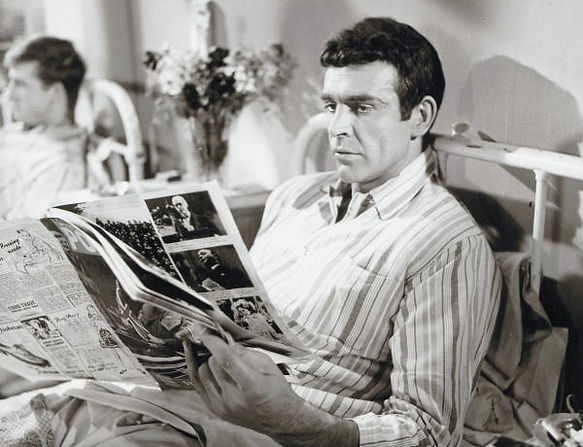.jpg)
Connery as Pedlar Pascoe in On the Fiddle (1961)

Connery in a scene from the film Hell Drivers

Connery with star Janet Munro on the set of Darby O'Gill and the Little People (1959)

Jacqueline Hill as Grace and Connery as 'Mountain' McClintock in Requiem for a Heavyweight
Although his role was relatively minor, he had the opportunity to strut around in his leather jacket to great acclaim and get involved in a few fights. In retrospect, Hell Drivers, which was a resounding box-office flop, looks like a valiant attempt to free British cinema from its quaint, gentrified shackles, to try to harness the energy of Hollywood films like "The Wild Ones" or "The Wages of Fear" from the continent.
That same year he appeared in the theatrical production of Epitaph and played a supporting role as a thug in the "Ladies of the Manor" episode of the BBC television series "Dixon of Dock Green". He also had small television roles in "Sailor of Fortune" and "The Jack Benny Program".
Connery's first big hit, with Requiem for a Heavyweight, did not boost his career as one might expect. Fox had no idea how to use it and let it languish under contract, occasionally releasing it to other studios. Rod Serling's Requiem for a Heavyweight was broadcast live on American television in the mid-1950s, starring Jack Palance. Despite its sappiness, it was widely acclaimed. Along with works like Paddy Chayevsky's Marty, it was considered a new kind of drama that went against the grain of mainstream television and dared to show tragedy and failure, to be decidedly pessimistic, even if it meant upsetting advertisers. A year or two later, the BBC did its own version of Serling's story. They asked Palance to reprise his performance, but contractual obligations forced him to drop out at the last minute. Instead, ten days before the broadcast, the producers hired a struggling young Scottish actor and former bodybuilder. With his Celtic, brooding and monumental air, there could hardly be a more appropriate name for a Sean Connery character than Mountain McClintock.
Thus, he appeared opposite Lana Turner in Another Time, Another Place (1958) and was the romantic interest in Disney's 1959 quirky fable, Darby O'Gill and the Little People. Playing children is one thing; playing them alongside garden gnomes is quite another.
All in all, he seemed too dark and brooding a presence for a Disney family film. Along with Anthony Quayle, he was the villain chasing Bond's iconic predecessor, Tarzan (Gordon Scott), in Tarzan's Great Adventure (1959), but his Hollywood career seemed to flounder, from one start to the next.
Things changed a bit in 1957. He hired Richard Hatton as his agent, who landed him the role of Spike, a small-time gangster in Montgomery Tully's No Way Back. Later, Rakoff gave him his first chance at a starring role as Mountain McLintock in BBC's Requiem for a Heavyweight. He also played a rebellious truck driver in Cy Endfield's Hell Drivers (1957) and in Terence Young's MGM film Action of the Tiger. Terence Young would have a major influence on Connery's film career a few years later, when he was cast as James Bond in 1962. He also got another supporting role in Gerald Thomas' Time Lock (1957). He was beginning to make a name for himself.
1957 was also the year he met Australian actress Diane Cilento during the filming of a show for the British network ATV Playhouse. They were immediately attracted to each other, although Cilento was married at the time. Connery would marry her in 1962 and they had a son, Jason, who later followed in his father's acting footsteps. But the marriage did not last. They divorced in 1973 and Cilento returned to Queensland, Australia.
Connery got an important role in the melodrama Another Time, Another Place (1958), where he played a British reporter named Mark Trevor, who was involved in a love affair with Lana Turner and Barry Sullivan.
In 1960, Connery's film career began to take off. He landed a starring role in Robert Stevenson's “Darby O'Gill and the Little People” for Walt Disney Productions, a film about a wily Irishman and his ingenious fight against leprechauns. He also had prominent roles in Rudolph Cartier's productions, “Adventure Story” and “Anne Karenina” for BBC Television, co-starring Claire Bloom. In 1962, he appeared in “The Longest Day” alongside other stars, and it was the year Connery achieved his true success. Producers Harry Saltzman and Albert Broccoli chose him to star in a spy movie based on one of Ian Fleming's novels. James Bond was born.

Connery with Diane Cilento and their son Jason
Connery was reluctant to commit to a series of films, but was advised that if the films were successful, his career would benefit greatly.
Despite the frenetic atmosphere of the live soap opera and the need to learn a long role in barely a week, Connery managed to keep his cool, one of his trademarks, and his "strangely melancholy" performance was well received. It received good reviews in the Listener and the Times, and Connery was suddenly in demand. Soon after, after turning down offers from the Rank Organization, he signed with Twentieth-Century Fox on a seven-year contract.
It would be fascinating to see Connery in his first major role. Unfortunately, the BBC version of Requiem for a Heavyweight was not deemed worthy of preservation, so one can only speculate as to what his performance was really like. But it's hard to imagine another British actor who could have replaced Palance with such ease.
When he was re-signed to play Bond in Diamonds are Forever (1971), he demanded what is considered the best contract given to a star since Mary Pickford. She donated most of her fee to a Scottish educational foundation and insisted that United Artists finance two more films of her choice. The first of these (the second has yet to be shot) was Sidney Lumet's The Offence (1972), in which he played the not at all sympathetic role of a policeman corrupted by many years of service who loses his temper when confronted by an alleged child molester.

Connery signs autographs for fans
It was one of his best performances, but it seemed an unlikely role for a star so concerned about his looks that a few years later he would sue a magazine that had the temerity to suggest he was overweight.
The producers didn't mind stories about his tough childhood or his bodybuilding, but they quietly drew a thick veil over his earlier acting career. In fact, by the time he was cast as Doctor No, Connery was already an established actor. His first stage appearance was with Dame Anna Neagle, as an extra in a production of Sixty Glorious Years at the King's Theatre in Edinburgh.
It was on television that he had his greatest success. Her huge personality could hardly be contained by the medium: it was inevitable that she would make an impression. And he was lucky with his roles. He was cast as Alexander the Great in Terence Rattigan's Adventure Story. Then, in 1961, he landed the role of Vronsky in the BBC adaptation of Anna Karenina, directed by Rudolph Cartier. Here, he displays impressive aristocratic arrogance, as well as an early version of Connery's mustache, and counters Claire Bloom's cerebral performance in the central role with a certain earthy flamboyance.
Around that time, Connery also played Hotspur alongside Robert Hardy's Prince Hal in a stuffy BBC adaptation of Shakespeare's historical plays, The Age of Kings. Again, he is physically relaxed, does not flinch at all when speaking in verse, and is considerably more dynamic than the leaden Shakespearean actors around him.
In 1961, he had his first starring film role, opposite Alfred Lynch in Cyril Frankel's On the Fiddle, a wacky English comedy of the sort that would make Truffaut throw his hands on his head in horror. Set in the war years, it features a remarkable list of actors in supporting roles, from John Le Mesurier to Wilfred Hyde White and even Barbara Windsor. It tells the story of a neighborhood delinquent, played by Lynch, who is forced to enlist to avoid a court fine.


On board the helicopter in You Only Live Twice and playing golf in the movie Goldfinger
Saltzman and Broccoli, already seasoned producers, had acquired the rights to Ian Fleming's popular novels about Agent 007 and had just received clearance from United Artists to bring Doctor No to the big screen. (Plans to use Operation Thunder as the first film fell through due to legal wrangling). The newly founded Eon Productions began work in earnest, laying the groundwork for a franchise and searching for the most important and elusive piece of the puzzle: its leading man.
After deep consideration, Cary Grant was cast and given the role. The contract was drafted and all but signed when the Hollywood leading man revealed that he would only do one film. Grant was already 58 years old and refused to commit to a series. However, Saltzman and Broccoli still envisioned Dr. No as the first film in a franchise, and were forced to scrap their first choice for Bond.
Other names were tossed around, such as Patrick McGoohan, famous for The Prisoner, and David Niven (who was also over 50 at the time). The director hired to direct Dr. No, Terence Young, was pushing for Shakespearean actor Richard Johnson to accept the role. Even Roger Moore, a future 007, was considered, though Broccoli deemed him “too young, and perhaps too handsome.”
And then Fleming himself stepped in. The author chose an actor named Richard Todd, the performer who had played Commander Guy Gibson in The Dam Busters. He was tall, handsome and commanded the screen; the perfect Bond. But Saltzman and Broccoli disagreed. No agreement was reached, and the search resumed.

Sean Connery with Ian Fleming, the writer of the James Bond novels
Around that time, The Daily Express decided to launch a contest: “Find James Bond”. It was 1961, and columnist Pat Lewis was determined to do his bit in the search for the superspy. Six finalists were chosen, and all did camera tests for Broccoli, Saltzman and Fleming. Once again, one candidate was chosen from among them all: a 28-year-old model, Peter Anthony. However, despite his Gregory Peck-like looks and enthusiasm, he proved to be an unsuitable actor.
And so came Connery. At least a decade younger than most serious candidates, he was a complete outsider for the role. He lacked the acting experience of Cary Grant or David Niven. Fleming reviled him, referring to Connery as "the working-class Scot" and telling the producers, "I'm looking for Commander Bond, not a grown-up stunt double." Nevertheless, Broccoli and Saltzman agreed to have lunch with the actor.

Connery in the film Thunderball

Photo of Connery in Thunderball
It didn't make the best first impression. Connery arrived at the restaurant looking disheveled, and Broccoli, in particular, recalled that he was wearing unironed clothes and looked disheveled. But Dana Broccoli, Cubby's wife, had convinced her husband to give Connery a chance, and there they were, sitting across the table from the man who would be Bond.
By the end of the meal, the 32-year-old Scotsman had landed the role. He had never had an official camera test for the part because, despite his gaunt appearance, Connery delivered an assertive, brash and masculine performance over lunch, proving his mettle, confidence and acting ability to the producers. But what really sealed the victory was his exit. As he got up from the table and returned to his car, Saltzman and Broccoli watched Connery out the window. “He was moving,” Saltzman recalled, “like a feline.”

Sean Connery and Donald Pleasence (Blofeld) in the film You Only Live Twice

Connery with Adolfo Celi (Emilio Largo) in Thunderball

Connery with Ursula Andress in the film 007 against Doctor No
But while Connery may have had his feline sensibility, there was still a long way to go. The Scotsman featured something of an Eliza Doolittle, and director Terence Young - who also saw the Bond jewel in Connery's skin - decided to take the actor under his wing to prepare him for the role. Young accompanied Connery to his personal hairdresser for a good hairdo, and to his tailor, Anthony Sinclair, to try on new and stylish suits. He taught him how to be James Bond.
And Ian Fleming, still furious from the sidelines, would soon swallow his words. The author's girlfriend, Blanche Blackwell, tried to convince Fleming that Connery possessed the pure masculinity and sexual charisma needed for the role, but Fleming remained reluctant. It was only after leaving the premiere of Dr. No that Fleming made a radical about-face.
Suddenly, after seeing Connery in action and his creation come to life, Fleming proclaimed his admiration and adoration for the actor. In fact, he was so captivated by his performance that in his penultimate 007 novel, You Only Live Twice, Fleming endowed the character with Scottish ancestry, similar to Connery's.

Sean Connery during a break from filming 007 vs. Doctor No

Sean Connery with Ian Fleming and Bond series producers Saltzman and Broccoli

Sean Connery in a scene from the film Diamonds Are Forever

Connery with Gert Fröbe, in the film Goldfinger
The rest is film history. Connery starred in six official Bond films, plus the 1983 independent film Never Say Never Again. His portrayal of the character has become a pop culture legend, defining modern masculinity and being considered the ultimate ideal of a gentleman. A national poll chose Connery as the greatest Bond ever, with 56% of the votes cast. Not a bad legacy for a working-class Scot....